
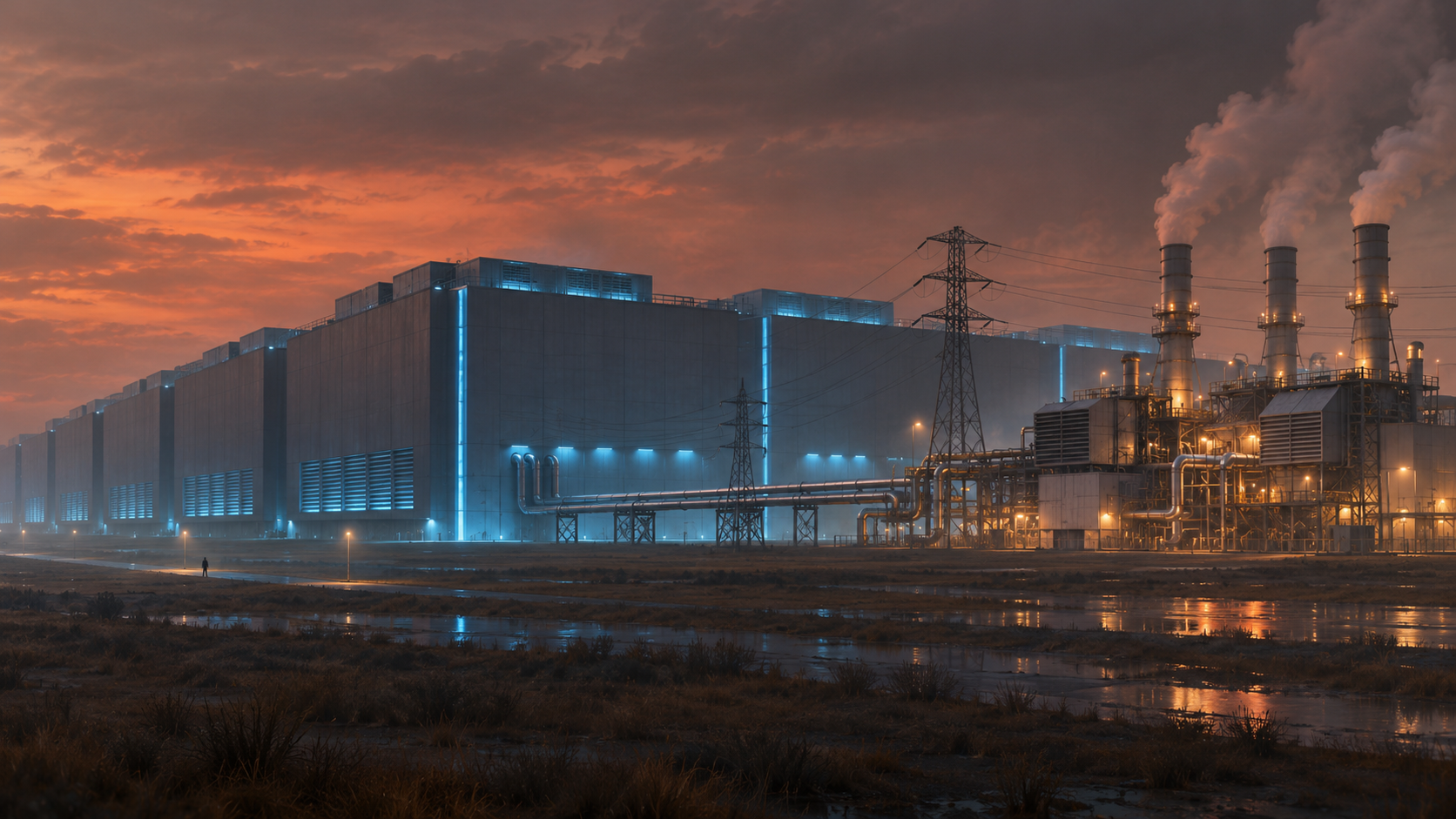
Outside Brownsville, Texas, a $24 billion "data center and power plant" is planned on 444.45 acres of land. The land was de-annexed for $220 million in water and wastewater projects, and Brownsville's 90-day moratorium had taken effect the week before. That is one site. Data centres are also planning their own gas-fired generation alongside grid supply. This article looks at what that choice adds to the climate bill, and who gets left to plan the rest.
A pipeline the size of a grid
On 11 November 2026, BloombergNEF released "Powering the Data Center Boom," commissioned by Bloomberg Philanthropies. Its headline finding is that it has tracked 181 gigawatts of announced gas-fired generation proposed alongside data centres. More than 90 per cent of that is in the United States.
The figure counts announcements, not finished plants. BloombergNEF itself is careful about the difference. It describes the pipeline as "an indication of potential scale rather than a forecast of what will ultimately be built."
The same release expects data-centre electricity demand to almost quadruple to 2,354 terawatt-hours by 2035. The gas pipeline is the supply side of that growth.
What the emissions figure does and does not mean
If all of the announced plants were built, BloombergNEF estimates they would emit about 345 million metric tons of carbon dioxide equivalent a year. That is the total from the plants. It is not the extra they add over the grid.
The extra is the more useful comparison. BloombergNEF estimates that on-site gas for the same data-centre capacity would emit 152 million tons more a year than average US grid electricity. The release puts that difference at about ten per cent of US power-sector emissions in 2025.
Our reading: the 345 million tons is the right number for asking how much a gas-fired build-out would emit. The 152 million tons is the right number for asking what the build-out costs relative to the grid. A reader who quotes only one of them will tell a different story.
There is a second, slower risk. BloombergNEF warns that once a plant is online, it may keep running after the grid arrives, creating "a longer-term fossil-fuel lock-in risk." A power plant built as a bridge can become the permanent supply.
Where the utilities stand
Latitude Media, writing on 10 November 2026, looked at the utility side of the same question. Its analysis, which rests on assumptions about vertically integrated utilities and a 65 per cent utilisation rate, finds that for signed data-centre load, utility plans would cover about 45 per cent with new gas and about 30 per cent with carbon-free sources. Counting only approved projects, the carbon-free share falls to about 15 per cent. About 120 terawatt-hours, roughly a quarter of the total, has no planned supply at all.
Data centres are also planning their own generation. Latitude reports 73.7 gigawatts of it, almost all using gas.
Latitude's figures depend on its own method. They describe the gap in planned supply, not the plants that will eventually be built. Readers should treat them as one estimate of the gap, not as a count of what is coming.
Brownsville as a test case
The Brownsville project shows how a single deal can connect land, water and power. The Texas Tribune reported the $24 billion figure and the $220 million water and wastewater arrangement on 10 November 2026. It also reported that, had the land stayed inside city limits, the project "likely would have had to find a different location," because of the moratorium.
That is the local side of the national question. A city that wants investment can offer land and water. The power plant, and the climate consequences of its emissions, go along with it.
Implications
Three groups carry most of the risk.
The first is the climate budget. BloombergNEF's 345 million tons is the total if the announced plants were built. Our reading: because of the lock-in risk it describes, the cost may not end when the data-centre boom does.
The second is ratepayers and grid planners. If utilities plan for about 45 per cent new gas and leave a quarter of signed load unplanned, someone will have to supply the gap. Data centres plan 73.7 GW of their own generation, almost all gas. Our reading: some of the gap may be filled by that on-site gas, but Latitude's figures do not show it.
The third is the communities that host these projects. Our reading: a city that trades land and water for a power plant may be giving up more than it gets. The Brownsville moratorium shows how quickly local rules become a negotiating point.
Conclusion: the grid is not the only option
Our reading: an on-site plant suits a buyer who wants power on its own timeline, and it puts much of the cost on everyone else. The fair comparison is the one BloombergNEF draws: the plants' total emissions on one side, and the grid they bypass on the other. Whether the gap is closed with gas or with cleaner supply is the decision the next few years will settle.
Sources: BloombergNEF, "Powering the Data Center Boom" (11 November 2026); Latitude Media, analysis of utility plans for data-centre load (10 November 2026); Texas Tribune, report on the SpaceX Brownsville project (10 November 2026).