
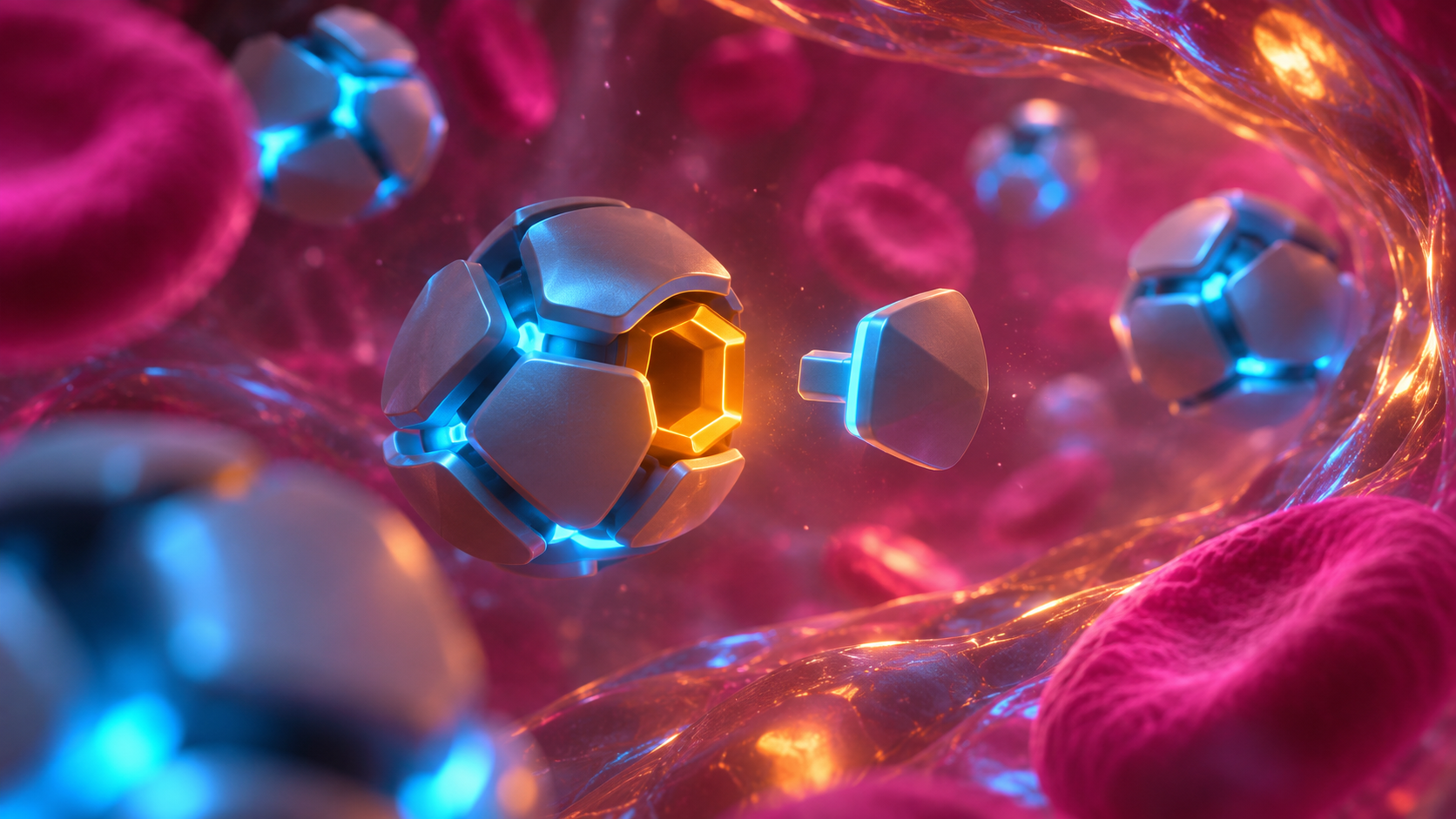
Imagine a machine smaller than a cell that arrives in pieces, clicks itself together inside a dish, does its job, and is pulled back out with a magnet so its parts can be swapped and reused. That is no longer a thought experiment. In June, researchers at the University of Basel described exactly that kind of device. In the same season, Chinese teams reported enzyme-driven particles that steer toward tumours in mice, and a separate group used AI models to design working bacteriophages. Taken one at a time, each result is a lab milestone. Together they raise a question no one has answered well: what happens when a modular machine meets a design tool that can write new biology?
Parts That Snap Together
The Basel work, led by Voichita Mihali in Cornelia Palivan's group with collaborators at Heidelberg, appeared in Advanced Functional Materials in 2026. Its nanorobot is built from two modules. One is a propulsion unit that responds to a magnetic field. The other is a payload capsule that carries the substance the robot is meant to deliver. The modules are joined by a DNA-based fastener, which the university's release describes as a "Velcro" system: complementary DNA strands on each part let them couple and separate in a programmable way.
Modularity is the point. A propulsion unit can be paired with different payloads, much as a machinist swaps drill bits in one chuck. The team reports that the modules can be separated, reloaded and recombined. The magnet matters for a second reason: because the propulsion unit can be steered, it can also be retrieved after the task is done.
The headline result is modest by clinical standards. In experiments with HeLa cells, a human cancer cell line, the robots accumulated on the cell surfaces. They also reduced cell viability to 16 per cent within 72 hours. The release says the robots synthesised an anticancer drug on site. These are results from cells in culture. The release mentions no animal studies and calls human use a long-term goal. A dish is not a body, and nothing in this paper shows what happens in one.
Enzymes That Steer
A second line of work takes a different route to the same destination. Chinese researchers have reported nanorobots powered by enzymes, which generate motion from chemical reactions in the fluid around them. The work, published in National Science Review (December 2025, per a secondary summary), describes particles that move along a chemical gradient toward tumour tissue. The research uses the term chemotaxis, the same word a bacterium uses when it swims toward food.
In mice with breast tumours, the authors report that the bienzyme nanorobots increased tumour-targeting delivery efficiency 209-fold compared with passive particles. They also report more than a tenfold increase in penetration depth and a 1,970-fold increase in cellular uptake. Those figures come to us through a commentary that cites the original study. We have not read the original abstract, so they should be treated as the authors' claims, as reported, and not as independently checked numbers.
A news framing for this work has said a company was launched to commercialise it. We could not find that launch in the paper, the commentary or any company announcement, so it is not claimed here. The gap matters. A research result and a product are different things, and the public story often merges them.
Designing Biology With Machines
The third strand is the one that changes the stakes. In a study led by Samuel King and Brian Hie at Arc Institute and Stanford, researchers used two genome language models, Evo 1 and Evo 2, to write complete bacteriophage genomes. They used the phage ΦX174 as the template. Of the designed genomes that were built in the laboratory, 16 produced viable phages. A cocktail of the generated phages overcame ΦX174 resistance in three strains of E. coli. The work was posted as a preprint in September 2025 and reportedly later appeared in Science in August 2026, per secondary coverage.
Note what the work is, because the headlines often blur it. A bacteriophage infects bacteria. These phages were designed to kill E. coli, not to infect people or animals. The study shows that generative models can write genomes that function. It does not show that they can write a virus that infects humans, and the story should not say so.
Even so, the capability is real and the direction is clear. A model that can write a working genome is a design tool, and design tools improve. The same models that help a lab find an alternative to antibiotic-resistant bacteria could, in principle, be pointed at other organisms. Whether any such effort would succeed is a separate question, and nothing in the cited papers answers it.
What Happens When the Pieces Meet
Here is the convergence the Basel and Chinese work points toward. A reusable nanoscale platform gives you a body that can be retargeted, retrieved and refilled. A generative model gives you a way to design the cargo, the enzyme, or the genome that goes inside. Neither is dangerous on its own in the sense that matters for a pandemic or a poisoning. Combined, they shorten the distance between an idea and a working agent.
The people who benefit first are the labs and companies that can afford both halves: the chemists building the platform and the groups with access to the design tools and synthesis capacity. Patients with tumours who could be treated more precisely also benefit, and that potential is real. The people who lose are harder to name, because they are the ones who would be exposed to a misused design: a community, a food supply, a hospital ward.
Governance has not kept pace. Nanomedicine is reviewed through trial regulators, one device and one indication at a time. In our reading, generative biology is governed, where it is governed at all, through voluntary commitments and the screening of DNA synthesis orders. Neither framework was written with a modular, reusable, AI-designed agent in mind. The gap is not that any single rule is missing. It is that the rules were drafted for objects, while the risk now comes from a pipeline.
Conclusion: Build Pieces, Then Write the Rules
The Basel nanorobot is elegant. Its parts click together, its magnet brings it home, and its cargo can be swapped. The Chinese enzymes are clever, steering through a tumour's chemistry toward their target. The phage study shows that a model can write genomes that work. Each result stays inside the laboratory for now, and each deserves that caution.
But the lesson of the last few months is not about any one device. It is about how the pieces will combine, and about the speed at which a design tool can offer a new combination. Governance tends to arrive after the thing it governs has spread. This time the pieces are arriving in the same season. Who will write the rules for a machine that is built from parts, and designed by a model that never sees a dish?