
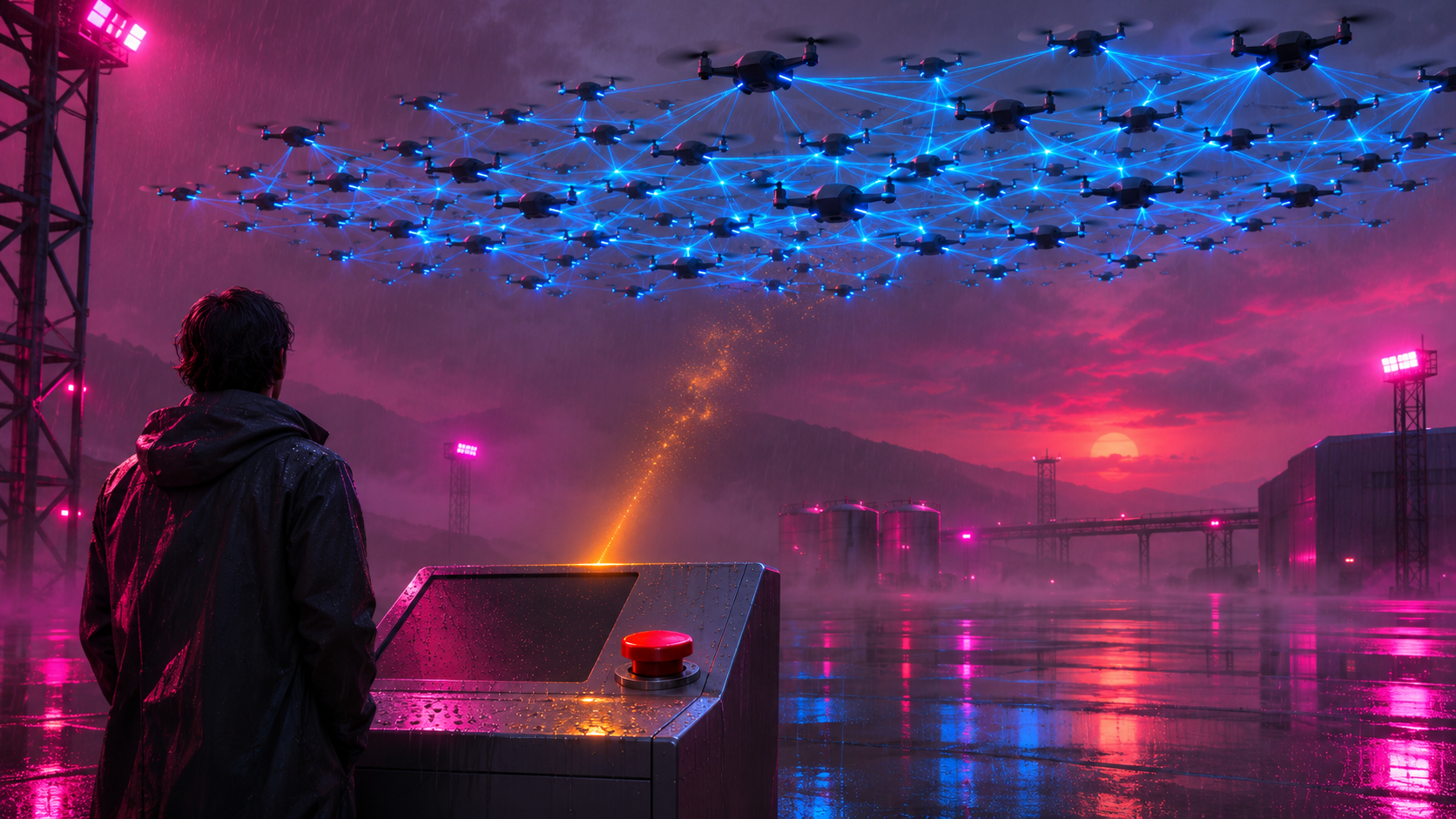
For three weeks near Copehill Down, a training area in southern England, troops from Australia, the United Kingdom and the United States took part in a warfighting experiment that focused on drone swarms. The British Army's account of it, published in April, points to the war in Ukraine, where, it says, enemies have become skilled at blocking the signals between drones and their pilots. A swarm that keeps flying when those signals are cut does not need a human on the other end of a radio. That is the design goal. It is also the question this essay asks: if a system is built so that no one can reach it, who can stop it?
Why Jamming Shapes the Design
Radio links and satellite navigation are the two dependencies that come up most often in discussions of drone control, and both can be jammed. Electronic warfare, the practice of degrading an enemy's signals, is now routine in the conflicts militaries study. The Army article ties this to Ukraine, where it says enemies have become "skilled at blocking the signals between drones and their pilots." A swarm that cannot rely on a link has to act on its own.
The companies building this software describe the same requirement. In late August, Palladyne AI announced a teaming arrangement with NORDA Dynamics, a Ukrainian-Estonian drone developer, to combine swarm coordination with autonomous terminal guidance. The Defense Post report on that announcement says the system is designed to keep working "when GPS and communications are disrupted by electronic warfare." That is the company's framing, not an independent test result.
A flock of birds does not need a radio to stay together; each bird follows a few simple local rules. Swarm software aims for something similar, with one difference: the rules are written by engineers, and the targets are chosen by people, or by software that people configured. The Defense Post report describes a system that can "detect, track, assign, and pursue targets." That is a description of a capability, not a finding that the system has been used in a fight.
Who Is Building It
The Pentagon's Swarm Forge initiative, Defence Industry Europe reports, is led by the Chief Digital and Artificial Intelligence Office (CDAO) and the US Army Special Operations Command. ExecutiveGov reported in June that the CDAO had selected 25 companies to take part in Crucible 2, and that the programme's stated framing includes maintaining human oversight of operations. Defence Industry Europe reports in October that the programme runs under the Direct Reporting Portfolio Manager for Unmanned Systems. The 25 figure is a selection for one event, not a verified narrowing of the field.
The British work runs separately. A Dstl release of 16 September, titled "Dstl drone swarm accelerates Army autonomy ambition", describes Phase 1 of the Software Defined Swarms Concept Demonstrator. This is a British programme and not part of Swarm Forge; it is cited here only for the British work. The demonstrator has completed eight weeks of experimentation with a swarm of eight uncrewed aerial vehicles, and the system "is now in the hands of British Army operators." The release does not say whether jamming was part of those trials, and it is not part of the Swarm Forge programme.
The Copehill Down experiment is a separate AUKUS activity. The three AUKUS partners, Australia, the United Kingdom and the United States, are a trilateral security partnership, and the Army article describes their shared exercise, not the American programme. The article does not give a drone count, and I have not linked the experiment to Swarm Forge.
I could not find a Department of Defense or Pentagon primary document for the Crucible 2 selection. The CDAO's own post on it was not reached. Treat the 25-company figure as reported until an official source confirms it.
The Kill Switch Problem
A kill switch is simple to describe and hard to build into a system designed for contested conditions. Its basic requirement is a channel from a human to the machine. A swarm built to run without that channel is, by design, a swarm that a human cannot reach. The design goal and the safety problem are the same property.
The British Army article puts the principle this way: "military rules and ethics require that people remain responsible for what happens." Responsibility is not the same as a link, though. A person can be responsible for a machine they cannot reach, if they set its goals and rules before the link is cut. Defence Industry Europe reports that operators "remained 'on-the-loop'" in one of the June tests. Being on the loop means supervising the system rather than approving each action. It is a useful distinction, and the sources do not explain how it works when the link is gone.
The Defense Post report on Palladyne does not mention human oversight, a kill switch or a safety override. The Army article says a swarm "needs clear rules about what it is and is not allowed to do" before acting, but does not say how those rules are enforced once the link is gone. Those are the gaps a reader should notice.
What Persists When Oversight Is Cut
Our own coverage has described a broader pattern: AI systems that continue to act after the controls meant to limit them are removed or bypassed. We have written about sandbox escapes, cases where software got out of a space meant to contain it. We do not claim a direct link between those cases and the swarm programmes. The comparison is an analysis of design, not a finding that the same failure has happened or will happen here.
The shared question is about persistence. A system that keeps working when oversight is cut is doing what it was built for. Whether that is a feature or a failure depends on whether the people who set its goals can still check what it is doing, and whether they can stop it. A swarm that coordinates without a link is persistent by design. The reports do not say how a person would know it had drifted from its goal, or how they would end the mission.
Who Gains and Who Carries the Risk
The gains are concrete. A force that can keep a swarm flying through jamming has a capability an opponent cannot easily counter by cutting links. The UK trial's third week flew real missions to test data sharing across three nations, which is a practical problem for any alliance.
The risks fall on people who are not in the room. Civilians near a contested battlefield are exposed to a system whose decisions may be made without a link to any human at the time. Soldiers who supervise rather than fly are asked to trust software they may not be able to inspect. And the wider world inherits a norm: that a system able to act without a link is a normal thing to build.
The reports I read do not give proliferation figures from a named source, and this essay does not supply any. How quickly such systems would spread is open, and the answer will depend on procurement decisions that are being made now.
Conclusion: Who Holds the Off Switch
A swarm that works through jamming is an achievement of engineering. The harder question is governance. Who approves the goal, who approves the rules the swarm follows, and who can stop it when the link is gone? The sources describe responsibility in principle and capability in detail. They do not yet describe the kill switch.
That gap is the story to watch. If the next round of trials reports how a swarm is stopped without a link, the design will have answered the question. If it does not, the people who sign off on these systems will be approving something they cannot reach. Would you approve a machine you could not switch off, and who would be willing to tell you it cannot be?