Think about the night of 31 October 2026. By the evening, the Earth's magnetic field had been pushed hard enough for NOAA's planetary index to reach a Kp of 6 on the scale that runs from 0 to 9. That is a G2 storm, which NOAA calls moderate. A storm of that size can disturb radio, navigation and power systems. The quiet days are part of the story, too.
What a geomagnetic storm is
A geomagnetic storm happens when the solar wind, the stream of charged particles flowing outward from the Sun, presses hard on the Earth's magnetic field. NOAA's Space Weather Prediction Center rates storms on a scale from G1, minor, to G5, extreme. The rating comes from the Kp index, which measures how disturbed the field is in each three-hour window. A Kp of 5 is G1, a Kp of 6 is G2, and so on.
The most famous storms are driven by coronal mass ejections, huge eruptions of plasma from the Sun. Many of the storms that matter for daily operations come from something quieter: coronal holes, regions where the Sun's magnetic field opens into space and lets fast streams of solar wind escape.
Two storms in a month
NOAA's daily geomagnetic indices show the pattern clearly. On 31 October 2026, the Kp index reached 6.00 in one three-hour window, a G2 storm. Its daily Ap index was 24.
On 7 November, the peak Kp was 5.33, a G1 storm. The following day, 8 November, opened with a Kp of 5.00 in its first three-hour window, also at the G1 level. The Ap index for 7 November was 22, and for 8 November it was 21.
The source material for this essay attributes the 7 November storm to a coronal hole stream. We have not checked that attribution against NOAA's own coronal-hole records, so it is reported here as a claim, not as a checked fact.
The forecasts ahead
NOAA's three-day geomagnetic forecast, issued on 14 November 2026, predicts a highest Kp of 1.67 for 15 November, 3.33 for 16 November and 4.67 for 17 November. No value reaches 5 in that period, so no storm is forecast over the three days. NOAA's own forecast assigns a 40 per cent chance of minor storm conditions on 17 November.
NOAA's 27-day outlook, issued on 9 November, is a different and less certain product. It forecasts a highest Kp of 5 on 17 and 18 November, which is G1 level, and on several later days up to 27 November and 4 December. It does not list any G3 level. The outlook was issued earlier than the three-day forecast, so readers should treat it as a planning guide, not a live warning.
What the grid feels
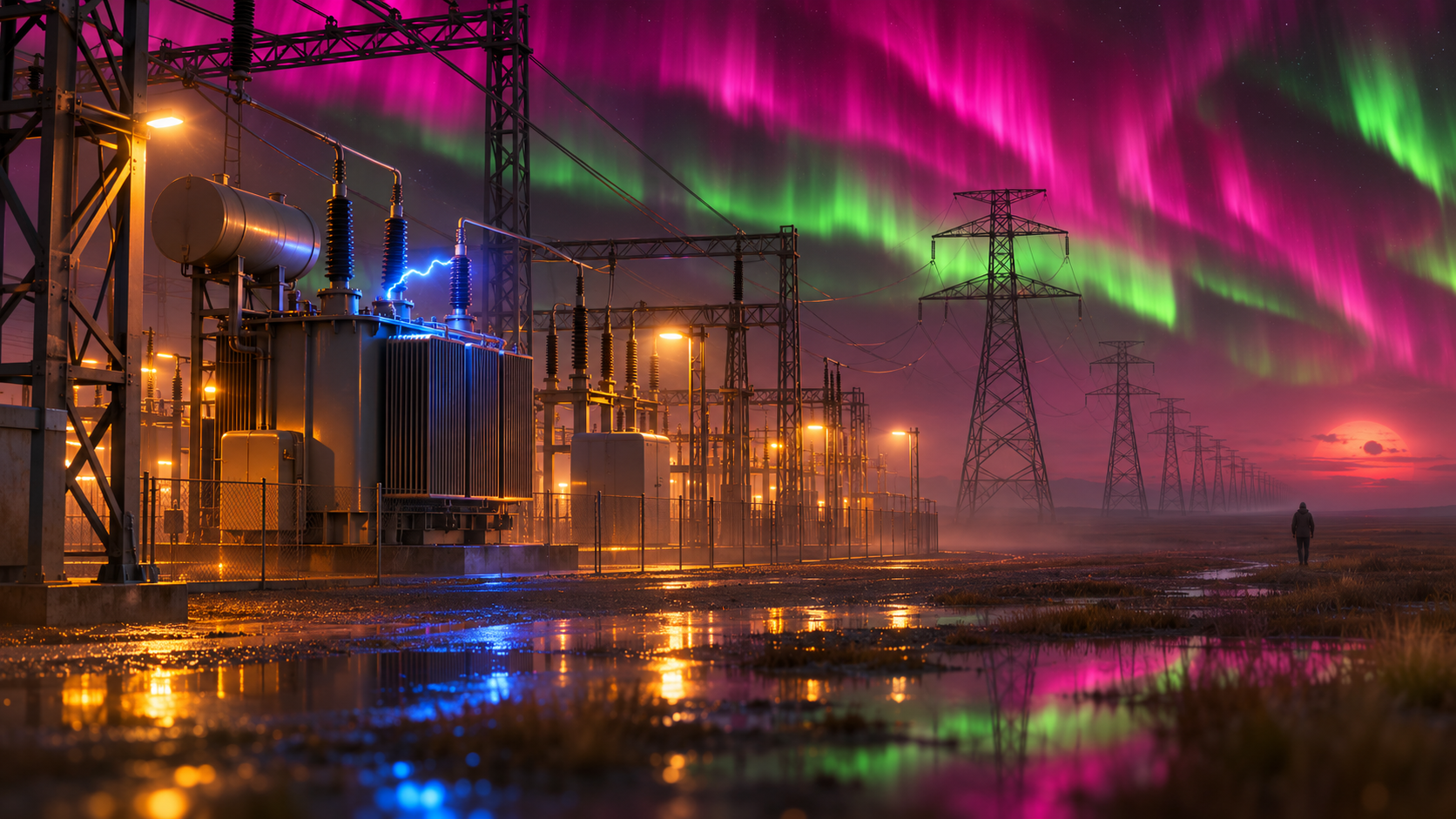
Minor storms are not dangerous in the way a major storm is. The concern is that they are frequent enough to add strain, and that the systems they affect are built for a different load. Geomagnetically induced currents can flow through long power lines and transformers during a storm, and repeated events can wear equipment. Satellite drag rises during storms, and GPS accuracy can degrade.
Our reading: data centres are concentrated in a few regions, and their load is growing. A strain on a regional grid that once served homes and factories now also serves large computing facilities. Our reading: a grid that was designed around ordinary weather is being asked to carry more, and the margin for a bad storm is smaller than it was.
The British Geological Survey's November 2025 alert on a "cannibal storm" is not part of the NOAA data behind this essay, so it is not used here.
Implications
Three groups carry most of the exposure.
The first is grid operators in regions with long high-voltage lines and limited redundancy. Their risk is less about any single storm than about the sequence of storms that leaves equipment already stressed.
The second is satellite operators and users of satellite navigation. Drag and positioning errors are not visible to most people until something breaks.
The third is the public, who rarely hear about a G1 or G2 storm at all. The alert system is built for the big events, and the small ones pass without notice. Speculation, labelled as ours: a public used to hearing nothing will be slow to act when a storm does matter.
What could go wrong is the usual pattern of infrastructure risk. A system with a small margin works fine until a bad day arrives in the wrong place.
Conclusion: the storms we barely notice
We tend to measure space weather by its worst days, but the quieter storms are the ones that test the systems people rely on every day. Two storms in a month, both at G1 or G2, are a reminder that the Sun does not need to be dramatic to matter. The right response is not alarm, but a grid and a set of satellites designed to expect the ordinary storm, not only the extraordinary one. That means planning for the storm that arrives on an ordinary Tuesday, not only for the one that makes the news.
Sources: NOAA Space Weather Prediction Center, daily geomagnetic indices (2026 October 30 to November 8), read through the NOAA text service; NOAA three-day geomagnetic forecast, issued 14 November 2026 (services.swpc.noaa.gov/text/3-day-geomag-forecast.txt); NOAA 27-day outlook, issued 9 November 2026 (services.swpc.noaa.gov/text/27-day-outlook.txt).