
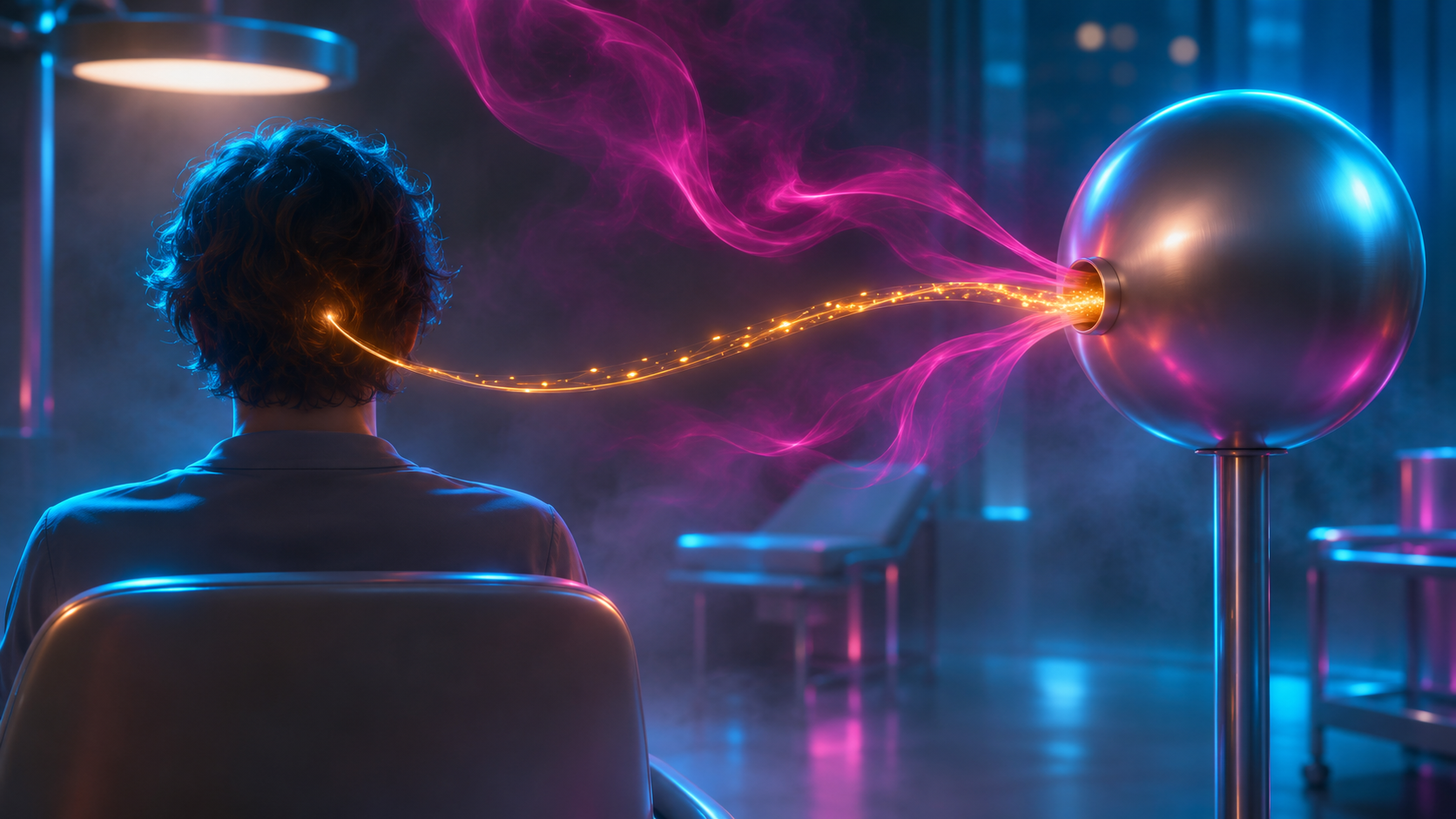
An individual in a completely locked-in state cannot speak or move. According to a conference release from the Society for Neuroscience meeting, that person has communicated independently for more than a year with a brain-computer interface that decodes intended movement from brain activity. A second team reports a portable brain-to-text decoder that the release says works "even on an iPhone." A third reports a synthetic voice that captures pitch, which carries the rise of a question and the weight of a word, and that is "allowing a patient to sing," in the release's words. Each result restores something that was lost. Each also raises a question the release does not address: when a machine turns brain signals into words, whose words are they, and who agreed to let them out?
Three preliminary results, and what the word carries
The release, dated 14 November 2026, comes from researchers at UC Davis, Massachusetts General Hospital and Georgia Institute of Technology/Emory University. It describes the work as presented at Neuroscience 2026, with a press event on Tuesday, 17 November. The release says the technology "is still largely experimental." Our reading is that the three results are preliminary: none is presented here as a clinical result, and the release gives no standard against which these devices could be judged.
Our reading: "preliminary" limits what the results prove, and it also describes the people taking part. They are part of an experiment whose risks are still being measured. That is a different position from a patient choosing a product, and consent begins there, not at the consumer device.
Intended speech, and where it stops
The release describes the locked-in result as decoding "intended movement." The phone result is described as brain-to-text decoding. These are different tasks, and the gap between them is where consent gets hard. Attempted speech is a signal a person chooses to make, even when the body cannot carry it out. Inner thought is not chosen in the same way. It runs through a mind without being addressed to anyone.
Our reading: a decoder built to read attempted speech could, in principle, be run against signals the person did not intend to send. The release does not say how the decoder separates the two, and nothing in these results shows a decoder reading inner thought. But a device that turns brain signals into text is designed to act on whatever signal it receives. The boundary between chosen speech and private thought therefore has to be enforced by design and by rules, not assumed.
Speculation: a device that works on a phone has a reason to gather as much signal as it can, because more data improves accuracy. That incentive points toward more collection than any single act of speech requires.
Consent when the person cannot say no
A person in a completely locked-in state cannot easily sign a form or refuse one. Medicine has long handled similar situations through a proxy, such as a family member or guardian who decides for a patient who cannot. That works while the proxy's interests match the patient's. It gives the patient's own voice little say when they do not.
Our reading: the release says the locked-in participant communicated independently, which means the decoder is itself a channel for the participant's answers. If that channel carries consent, its errors matter. A wrong word in a consent answer is not a small mistake, and a decoder that makes such mistakes would be deciding part of what the person agreed to. The release does not describe how the trial recorded consent, and we did not find that account in any source we read.
Consent that outlives the trial
A trial ends. A device on a phone may not. Consent given to take part in a study may cover that study's data, while a product could keep signal data for longer and use it to improve the model. The release says nothing about data retention, and no source we read addresses it.
Our reading: consent for a brain-data device should be treated as continuing, not as one signature at enrolment. A person who agreed in a hospital bed may not have agreed to a model trained on their signal years later.
Speculation: the first person to ask for their data back may be the one who had the least say when it was collected.
Implications: who holds the voice
Three groups carry most of the stakes. Participants gain a voice, and they carry the risk of an experiment that is still being measured. Families and carers gain a role they did not choose and may not be able to refuse. Companies and researchers gain data whose value comes from its intimacy, and that value grows with the amount collected. Each group has a reason to want the decoder to work, and a different reason to want its limits written down.
Our reading: the consent question is not a choice between helping and harming. It is a question about who decides what the decoder may hear, and who can change that decision later.
Conclusion: the voice is only half the return
The voice has returned, in a limited way, for people who lost it. The release gives a duration for one participant's independent communication, more than a year, a sentence about a patient who could sing, and a phrase about an iPhone. It gives no record of what each participant agreed to beyond taking part, and no account of what happens to the signal afterwards. Before the next result is presented as a restoration, the consent process deserves the same close reading as the decoder. Whoever says yes to a machine that speaks for them should keep the right to say no later.
--- Sources: EurekAlert, UC Davis, Massachusetts General Hospital and Georgia Institute of Technology/Emory University release, 14 November 2026 (
https://www.eurekalert.org/news-releases/1149828
). Quotations are checked against the release text. The release announces preliminary results presented at a conference; the papers and the trials' consent procedures were not read.