
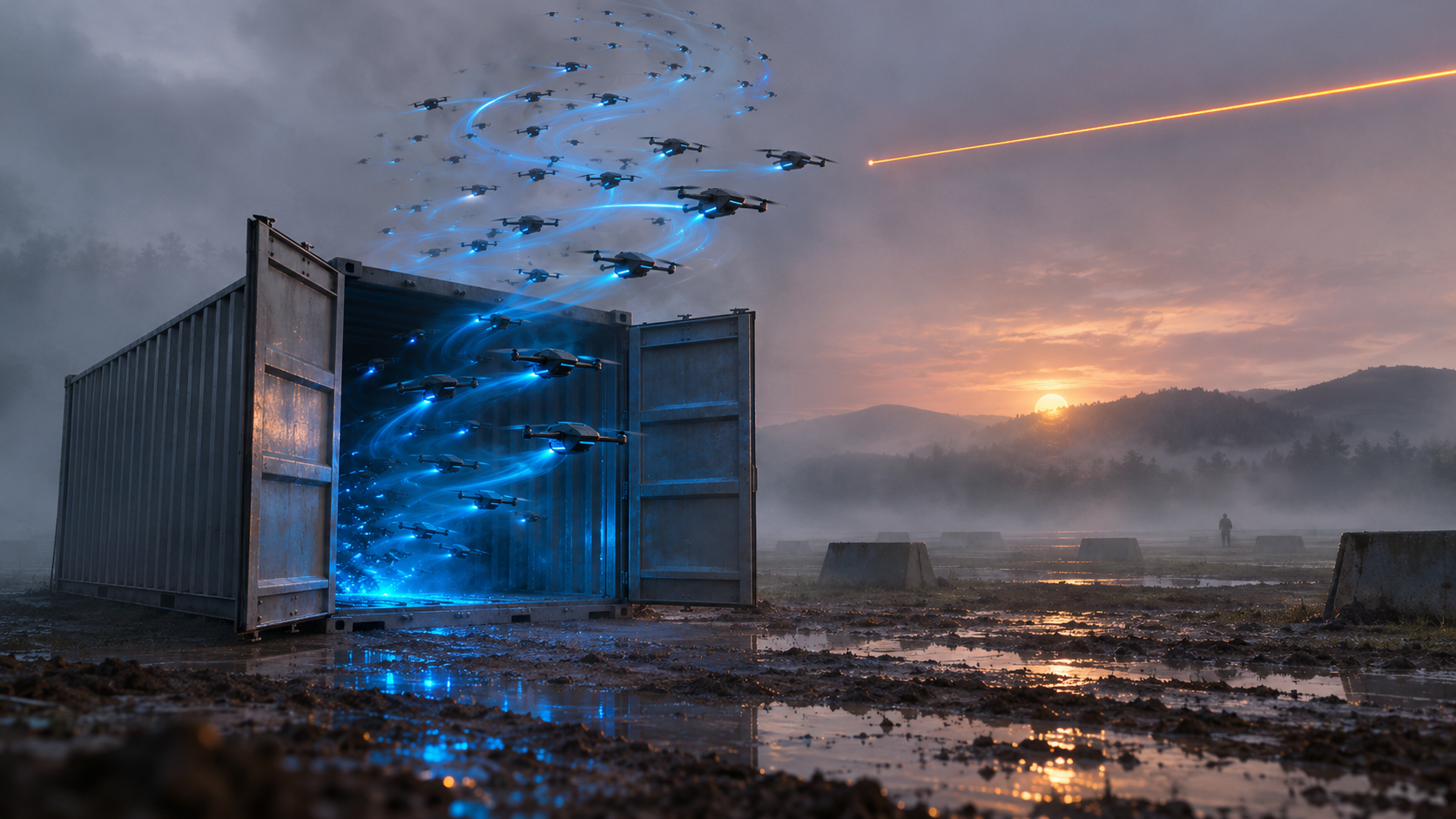
Think about a shipping container on a rail siding, a dock or a forest track. From the outside it is a box. Nothing in its shape tells an inspector whether it holds grain, spare parts or a vehicle that can drive itself out and launch an aircraft swarm. That ambiguity is not a flaw in the test. It is the design property the test was built to examine.
What the Army demonstrated
The exercise took place at the Grafenwoehr Training Area in Germany on 12 November 2026. Reports from Stars and Stripes and Army Recognition describe a sequence. A TRV-150 drone first dropped smoke. An uncrewed ground vehicle then emerged from a pre-positioned shipping container, and it launched a swarm of 18 small drones from an HIV3 swarm launcher. The vehicle is the R3NEGADE. The effort is called the Remote Rapid Response Autonomous Contingency Team, or R3ACT, according to Army Recognition. Stars and Stripes gives the program a slightly different name, the Remote Rapid Response Contingency Team, and reports the same drone count.
Army officials, as quoted by Army Recognition, described the exercise as "a technology evaluation with no announced procurement decision." No fielding timeline was given for the platforms. Stars and Stripes reports that the Army plans to keep experimenting with ways to make aerial drones "more deadly," and that the arsenal mixed military munitions with commercial technology.
We have not confirmed the purpose of any single element beyond what the Army has said. Some reporting refers to anti-tank missile launchers on other vehicles in the exercise. We have not verified those details, so this essay does not rely on them.
Verification: the hard part is seeing the payload
Arms control has always depended on being able to tell what something is. Inspectors count launchers, check missile tubes and look for telltale heat. A container breaks that method. It can hold a launcher, a vehicle, a stock of drones or nothing at all. A ground vehicle inside it can be unpacked and driven out in minutes.
The Army's own framing, in which the container is part of the system, makes the verification problem concrete. A rule that counts weapons on fixed sites will not catch a weapon that is stored as freight and assembled where it is needed. Our reading: any verification regime for autonomous launch systems has to deal with the container as a mobile and possibly ambiguous enclosure, not only with the weapons inside it.
The same ambiguity cuts the other way. An adversary inspecting a rival's shipping may see only freight, and so cannot tell whether a launch capability is present. Uncertainty on both sides makes both sides more cautious and less predictable.
Escalation: a launch with no visible lead-up
Escalation depends on warning. A military that sees forces moving can respond in time, and a launch that comes with a long, visible build-up gives both sides a chance to pause. A container launch removes most of that lead-up. The vehicle is already in place. The drones are already inside. The moment of launch can look, from a distance, like the moment of setup.
Our reading: when launch can happen from a box that looked like freight until the moment it opened, the window for a response shrinks. The decision to escalate has less time to be made by people who know what is happening.
The test also compresses the sequence in another way. A smoke drone goes first, and a swarm follows. Each step can be quick, and each step depends on a system working as designed. A small error in one step can propagate through all the others before anyone can stop it.
The activation link
The most important question is where the human decision sits. Col. Michael Weisman, a senior spokesman for the Army in Europe, told Stars and Stripes that "it is up to ground commanders how and where the systems are used." That line places the decision with commanders, but it does not say what link connects a commander to the vehicle in the container, how that link is protected, or who can break it.
Army Recognition describes "remotely activated, pre-positioned weapon systems," and DefConLevel says drones "could be stored and remotely deployed when needed." The reporting uses that language, so the question is fair to ask, even though this essay does not know how the program's link works. The general question is worth asking of any system that launches autonomously from a pre-positioned location. If a human sets the vehicle in place and later releases it by a link, then control depends on the security of that link as much as on the decision made at the start. A link can be jammed, spoofed or lost, and the system's behaviour when it is lost is a design choice.
Our reading: the activation link is the thing to examine. A "human in the loop" that sits at the moment of setup, rather than at the moment of launch, asks a different kind of trust of the people who stand by the system.
Implications
Three groups carry most of the stakes.
The first is the civilians who live and work near the places where such systems are staged. A container on a rail siding or a dock is part of ordinary logistics, and most people who pass one will never know what it holds.
The second is the adversary and the third parties who must judge capability from outside. The more a system looks like freight, the harder it is for anyone to judge the risk it poses, and the more likely it is that an outside observer will assume the worst.
The third is the commanders who will carry the responsibility for launch decisions made long before the launch. Their authority is real. Their ability to see what they are authorising may be less than it appears.
What could go wrong is familiar from other weapon systems: a capability fielded before the rules for using it are settled, and a launch that happens faster than the people accountable for it can follow. Speculation, labelled as ours: if a fielded version of this system is cheap enough to stage widely, the number of containers that might hold one becomes the verification problem, not the number of weapons.
Conclusion: the box is the message
A test that puts a swarm into the air from a shipping container shows a capability that the world's oversight methods were not designed to see. The Army describes it as a technology evaluation, with no decision and no timeline announced. That is a fair description of what happened on 12 November. It is not a reason to assume the question will wait. The sooner the rules for verifying, escalating and controlling such systems are written, the less likely it is that the first hard test will be a real one.
--- Sources: Stars and Stripes, 13 November 2026 (
https://www.stripes.com/branches/army/2026-11-13/containers-drones-munitions-test-germany-23453535.html
), on the Grafenwoehr exercise, the container, the 18 drones and the Army's stated aims; Army Recognition, 15 November 2026 (https://www.armyrecognition.com/news/army-news/2026/us-army-launches-18-drone-swarm-attack-from-ugv-in-germany-exercise-under-new-warfighting-strategy
), on the R3ACT name, the R3NEGADE vehicle, the HIV3 launcher and the technology-evaluation statement; DefConLevel, 13 November 2026 (https://www.defconlevel.com/alert/2026-11-13-us-army-evaluates-unmanned-capabilities-during-live-fire-demonstration-in-germany
), on the same exercise.